Sunday, March 7, 2010

A Teddy Bear Tea Party


I read somewhere that US Supreme Court Justice Clarence Thomas once said, "Good manners will open doors that the best education cannot." And with this at the back of my mind, I opened my big mouth one day and volunteered the idea of holding a teddy bear tea party for members of the Club Tipolo, a club that was set up by a group of mothers in the Antipolo area for the purpose of involving girls of varying school ages to learning activities that regular school are not able to include in the usual curriculum. Such activities mostly include arts and crafts and perhaps a little culinary angle in some, all with a particular theme in mind.

And so, after this idea was blurted out one very cold and windy December afternoon, it caught on, much to my surprise. I was told that it was something a bit different from their usual activities and there was more excitement about it when there were daughters of the organizers who found out about it and couldn't wait for the tea party to happen.

Having given such a "bright" idea, I likewise volunteered to be the one to give a short, short talk on proper tea etiquette since there are no tea etiquette gurus that we know of who can give such a talk. Frankly, I only know this much, and most of the things I know I only got from some books and magazines I have on the subject. As to having been actually invited to a proper tea party, I have no such experience. I don't know if having tea at the Victoria and Albert Museum in London some years past would count as such, but hey, I had tea and scones with clotted cream. In England. So as the preparations for the event started brewing, I had some qualms on how my young audience will receive the lecture part of the afternoon. I certainly had a program for it, and planning it down was seamless enough. However, I will later find out at the actual event itself that since the audience are still kids, it is better to keep the program loose and adaptable to any reactions. Having the party as a teddy bear tea, it kept the whole thing a bit informal and interesting for the girls.


I was surprised with the turnout too. There were 30 girls who showed up so it was really such a large crowd that it was quite hard to keep them interested in the finer points of the talk. I had to change my tactic and switched the whole tea etiquette thing to actual simulation, which they took on wholeheartedly - from the preparation of their own sandwiches, to the setting of their respective tables with complete tea amenities, and the actual drinking of tea, sandwiches, fruits and sweets. There were some girls too, who were converted to liking tea now that they've tasted it. The moms who attended, including me, discovered that underneath the girls' restlessness, they were quite serious in learning the etiquette of tea. Their caring nature were brought out as they took turns being "mother" or the hostess of the tea and ensured that each member of their group has what she liked. The whole exercise also calmed them as they sat on their tables and talked to their companions.

I got to thinking that, indeed, it is never too early to start teaching children the art of serving
tea. In this age in which there is the seemingly worsening prevalence of
inappropriateness coming in different shapes and sizes, it would only be just the right occasion to remind children of the importance of having and practicing good manners. Giving them such an opportunity
need not be so stiff and formal. After all, knowing the simple rituals of afternoon tea is none other than inculcating in young minds the importance of being considerate to others.

Afternoon Tea is also a time for adults to bond with their children or
grandchildren, or nieces and nephews. Thus, teaching them proper tea etiquette will certainly get them involved in a grown-up world.

The Menu

Sandwiches
Peanut Butter & Jelly
Hazelnut Spread
Cheese

Store-bought Cupcakes

Fresh Fruit Kebabs

Tea
Apple Juice

Some of the Finer Points:

1. Wait for the hostess to unfold the napkin and place it on her lap. This is a signal to the the guests to follow suit. If table linens are smaller tea napkins, unfold entirely and place on lap. Dinner napkins should be folded in half, with the fold facing the body. Napkins should not be placed on the table again until the end of tea or meal. It is the hostess who will be the first to do this, a silent indication that the tea is concluded.

2. Guests are given the option which they'd like to add to their tea - sugar, lemon or milk or all of them. However, etiquette dictates that milk is always poured in last, if this is desired at all. Lemons are served thinly sliced and not in wedges. These are conveyed to the cup with a fork.

3. When serving tea, the same should be done from the right side of the guest and pouring it until the cup is 3/4 full.

4. Maintain good posture at all times and don't reach across the table. Ask your seatmate nearest the desired food to pass the dish to you and thank him/her; take small bites of the food and listen to others when they speak.

A final point: A tea party is a good theme party for kids. Just keep the menu simple since it really doesn't take much to make children happy. You can involve your own kids in planning the menu since they would know better what their friends would like and enjoy eating.



Wednesday, February 17, 2010

Tumbet y Pescado


As the Lenten season begins, my thoughts fly to one of my favorite Spanish dishes - the Tumbet, which is a mediterranean dish hailing from Mallorca, one of the Balearic Islands of Spain (of which Ibiza is part). I first tasted this dish more than 10 years ago when La Tienda, the Spanish restaurant, offered this as part of their special menu in their Alabang branch during the month of October in celebration of their National Day.

While originally, the tumbet is a vegetable dish, La Tienda offered theirs with fish and baked in the traditional but individual earthenware greixonera. Since then, I've been replicating this dish myself, and have been serving it to my friends for dinner. This is very good served with a warm baguette than rice, and quite good as the star of the show. Nothing more simple than a complete meal in one pot. By the way, baking this dish in a pyrex tray is just as good.

The Recipe:

2 large aubergines or 5 local eggplants
salt & pepper
6 large or 9 small potatoes
2 large white onions, chopped
6 T. olive oil
2 T. garlic, minced
2 big green bell peppers, seeded & sliced
1 big red bell pepper, seeded & sliced
9 T. chopped fresh parsley
3-400 g. cans chopped tomatoes
2 t. paprika
3 T. red wine vinegar
1/2 kilo maya maya, labahita or cod fillets

Slice the aubergines or eggplants on the diagonal, as thin as you can and lay them on a tray. Sprinkle them with salt and leave to sweat 30-40 mins. Blot with kitchen towel. Peel potatoes and boil them in salted water. When almost cooked, lift them from water and slice into rounds. Saute onions briefly in low fire with olive oil then add garlic afterwards. Set vegetables aside.

Grease your baking dish (8 x8 in. & 3 in. deep preferably) with olive oil. As base, pour 1/3 of the first can of the tomatoes & its juice at the bottom of the dish and season with salt, pepper and paprika. Then layer with 1/3 each of the potato slices, aubergines/eggplants, fish, bell peppers, onions and garlic. Pour the remaining tomatoes and juice from the first can and season once again with salt, pepper and paprika. Repeat procedure until all ingredients are layered in then sprinkle the red wine vinegar and add 1 tablespoon on top of dish. Cover with aluminum foil and bake in preheated oven at 200 deg. C or 400 deg. F for 1 hour. Then remove foil and turn the heat to 170 deg.C/325 deg.F and give another 30 minutes to brown and concentrate the juices. Serve hot or cold. This dish also reheats well.

Note:
1. For variation and a little more flavor, you can add shredded queso de bola on top.
2. If crammed for time, omit the onions, garlic and cans of tomato and buy 2 bottles of
Bravo's Tomato and Garlic Dip and use this as the tomato sauce.

Wednesday, February 10, 2010

Newspaper Recipes

My love and adventure with food and cooking started with collecting recipes when I was a teen-ager in the 1980s. Yup, was very much in the middle of Generation X (and loving it) when my interest then was stimulated. I suppose I was more into baking than cooking, and the appliance being raved about was the turbo broiler, which deserves an entire article all its own. (Note to Self: Write a rhapsody on turbo broiler as next blog entry.)

But going back to the topic at hand, recipe collecting then was not as accessible as it is today, with the proliferation of cookbooks for sale, cooking shows on cable and live shows by our own homegrown talents, and of course, the internet. During the '80s, my school allowance did not give me room to buy cookbooks, and of course, the choices weren't as much varied as are found in newspapers. And it was way cheaper anyway. So, I would just cut out recipes from newspapers and even women's magazines such as Mod, Women's or Woman Today, courtesy usually of either the weekly columnists or advertised by food companies endorsing the use of their products as an essential ingredient for the success of the meal.

However, when my folders got messed up with all these bits of newsprint pasted on bond or typewriting paper, I decided that there must be a neater way of preserving my - ahem - research. So one summer vacation, my project was to transcribe all these collected recipes in Wordstar (!). Hey, trivia: does anyone out there still remember what this is??? Transcribing spilled over into the following schoolyear, but I did finish it and the pages since then have been compiled in a thick clearbook. There is a trade-off of course, and that is the fact that these cut-outs are art in themselves and are now gone.

But one evening, after several years of not leafing through this treasure trove, I checked it out for ideas and there were several dishes that stood out. My collection prove to feature pork chops or chicken meat as the main ingredients, but I managed to cut out a recipe for Menestra Con Cordero a la Riojana (Lamb Stew a la Riojana) and one for Sampaguita Ice Cream without any consciousness. I'm sharing some here that I've already tried out just in case it becomes useful to you. I apologize that I don't remember anymore from which newspapers I got them from, but I'm pretty sure you'll know which food product shared them in the first place. They will be hits for your family, as they have been for mine.

ORANGE-GLAZED CHULETAS

2 1/3 c. Sunquick orange
1 T. butter
1 T. chopped onion
3 slices old bread, cubed (about 1 1/2 cups)
3 t. orange peel
1/4 t. salt
6 pork chops
1 laurel leaf
1/8 tsp. pepper
2 T. cornstarch
1 orange, sliced for garnish

In a medium saucepan, melt butter. Add onion and saute until tender. Remove from heat. Add bread cubes, 2 1/2 t. orange peel, marjoram & salt and stir until well mixed. Moisten with 2 tablespoon Sunquick.

Slit pork chops from top midway through to produce pockets and stuff bread mixture in it. In the skillet, heat some oil and brown chops well on both sides over high heat. Add 1/2 cup Sunquick, laurel leaf, 1 t. each salt and pepper. Heat to boiling. Cover and simmer for 45 minutes. Turn occasionally. Add 1/4 cup Sunquick, if necessary to prevent from sticking. Discard laurel leaf.

Remove pork chops from pan; keep warm. Mix cornstarch and remaining Sunquick until smooth. Add cornstarch mixture to skillet and cook stirring occasionally until thickened and mixture boils. Add remaining orange peel. Serve sauce over chops.

SAFARANCHO (Easy Pork & Rice Dish)

1 T. oil
4 pork chops
1 medium onion, chopped
1 medium green pepper, coarsely chopped
1 cup uncooked rice
1/2 c. UFC Banana ketchup
1 t. Worcestershire sauce
salt & pepper
2 1/2 c. boiling water/broth

Pour oil in bottom of skillet and arrange meat on it. Add onion and green pepper. Sprinkle the rice on top. Add ketchup, Worcestershire sauce, salt & pepper. Pour boiling water or broth. Cover and simmer 45 minutes. Allow to stand 15 minutes before serving. Serves 4.

PORK CHOPS WITH GOLDEN STUFFING

4 pork chops, 3/4 inches thick
2 T. margarine
1 c. celery slices
1/2 c. chopped onion
1 8-oz. jar Cheez Whiz
2 T. water
6 oz. croutons

Brown chops in margarine then remove from skillet. Saute vegetables in skillet and remove from heat. Add 3/4 cup Cheez Whiz and water; stir until cheese spread is melted. Add croutons and mix lightly. Spoon into greased 8-in. square baking dish; top with chops. Bake at 350 deg. F oven. Top w/ remaining Cheez Whiz. Makes 4 servings.

Saturday, December 26, 2009

A Gift Idea from your Kitchen


After the rush that is the Noche Buena feast on Christmas Eve, it is only now that I found the time to write. Compared to last year's celebration that is labeled as our 4-country sojourn (5, if one has to be technical about separating the Vatican from Italy), this year has been the simplest most peaceful one. Our menu was a match to it as well - an Oven-Baked Ham with Pineapple Glaze as centerpiece, with Russian Potato Salad, slices of Quezo de Bola, and a salad of greens with olive oil-balsamic vinegar dressing as side dishes.

Earlier that evening though, I prepared something to be given to certain people in our gift-giving list. I thought of giving away something home-made, like my Chicken Pot Pie, which certainly gave a very personal touch after all the time and labor spent on it. A batch that's good for 5 ceramic containers (measuring 4 x 4 x 2 in.) was done quite easily and didn't require a lot of my time. Preparing the ingredients may, however, require more because of the chopping that is required. A helpful tip would be to do all the preparations early then take a breather before approaching the cooking proper, or have someone help you do it, while you do the cooking yourself.

Everything about the dish I made from scratch, including the pie crust, but you may want to lessen the labor intensity by buying a package of puff pastry usually available in the frozen section of supermarkets or at your favorite deli stores. (Just follow package instructions for preparing these.) I packaged each pie in blue ceramic containers I bought from the supermarket for PhP45 each, then when the pie had totally cooled from baking, I wrapped them in white cellophane sheets, tied with a red ribbon. A card that says "From the Kitchen of -" will make the recipient feel that the dish was especially made for him/her. Cheers!

Chicken Pot Pie

For the crust:

2 cups all-purpose flour
2/3 cup butter, softened but not melted
1 tsp. salt
6 T. cold water

For the chicken filling:

1 k. chicken breast cut into bite-sized pieces
1 red onion, minced
4 garlic cloves, minced
1 medium-sized carrot, cut into cubes
2 potatoes, cubed
1 small can whole mushrooms, sliced according to your liking
1 can vienna sausage, cut into smaller rounds
1 can condensed cream of mushroom soup
hot water, depending desired thickness of sauce
salt & pepper to taste

1. Make the pie crust: Mix the salt with the flour and add the butter. Blend together with fork or a pastry blender. The resulting mixture should look like cornmeal. Add cold water one tablespoon at a time and mix together until it forms into dough. (You don't have to use all the water, just until the dough forms together). Wrap with cling wrap and refrigerate for 30 minutes before using.

2. Make the chicken filling: Saute onions until for 1 minute then followed by garlic in a little corn oil. Follow with carrots and potatoes to allow time to cook these vegetables. Mix in the chicken bites until almost cooked (when meat has turned opague in color). Add in the mushrooms and the vienna sausage then season with salt and pepper to taste. Let simmer for 5 minutes to let ingredients cook through. Add the cream of mushroom soup and let simmer again for a few minutes. Check if the consistency of the sauce is to your liking, or else add hot water and check after a minute until you've achieved the consistency you like.

3. Assembly: Pour into ceramic dishes and distribute evenly. The chicken filling should only reach up to 3/4 of the dish rim. Set aside. Take out the pie dough from the refrigerator and set up your work table by sprinkling flour on the surface and that of your rolling pin (you can use a big and clean wine bottle as a rolling pin if you don't have one). Divide the dough by the number of ceramic dishes you have. Roll out the dough evenly on 4 sides then carefully put on top of one pie dish. The dough should fit over the rim and just cut away any excess. Fold dough over rim and press with tines of fork or thumb of your hand for a little design.

4. Bake in a preheated oven at 350 degrees for 15-20 minutes. There will be varying times for baking your pie depending on the make and model of your oven so you can only know if its done when the crusts have browned a little.

5. Cool the pies entirely before packaging them. The pies will keep for 3-4 days if refrigerated.


Sunday, November 29, 2009

Lutong Macau!


I really don't know where the Filipino connotation of "Lutong Macau" started. May I venture loosely into saying that we Filipinos usually use this phrase to mean that something is just made up, or that something was just cooked up, as in "cook the books." I now wonder if this is because Macau is principally a place you go to for gambling. Well, it's certainly the Las Vegas of the mainland China.

Of course, when an opportunity came up to visit Macau (read: free trip), who's to say one will not jump at the chance? With so many people I know who have been to Macau telling me that it's a worthwhile destination, I said why not? Why not indeed. And so my mother and I packed our bags for both our birthday trip and some mother and daughter bonding.

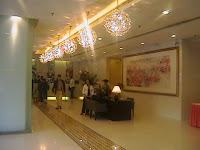
We chose a centrally located hotel in the main island of Macau. While Hotel Beverly Plaza is a
four-star hotel, it had simple straightforward amenities. I thought at first I may have made a mistake in choosing this hotel. This is because I've already confirmed our reservations when I decided to check out the reviews on the place, and the people who previously stayed there gave mixed reactions. Lucky for us, the quality of service has improved for the better. Unlike what the previous guests have been saying, the hotel staff are friendlier and more helpful. Toiletries and coffee and tea courtesy trays are complete and clean. Their breakfast buffet still needs a bit of improvement though, but on the whole, they serve a satisfactory spread of Cantonese and Western breakfast. Being a Filipino though, I was looking for fried rice. I suppose it's not a Cantonese thing. However, I got to taste a more or less authentic Pancit Canton, Macau being a Chinese Canton region rather than Mandarin or Fookien Chinese.


For people like my mother and I who do not gamble, the best thing to do in Macau is to eat! So our first destination upon arrival was to go to The Venetian and find out what is all the fuss about the place. From central Macau, we boarded the ferry shuttle to reach the station, and from there, one can choose to which hotel you'd like to go. So many of the hotels in the area offer free shuttle service to the tourists as an incentive (and may I say temptation) for people to gamble in their casinos. Once, when Macau has not opened to the world yet, there was only one casino to go to - the Hotel Casino Lisboa, which is actually a few minutes' walk away from our hotel. But when the tourist industry boomed and Macau opened its doors for foreign investors in 2004, so many casinos were built and opened. There are presently 30 casinos in Macau right now, and for a region that is only 30 square kilometers in area, the statistics would be that there is one casino for every square kilometer. And because of the competition among these casinos, casino hopping becomes easier and more convenient since they all offer free shuttle services. That's free trade and competition for you.

So, we boarded the shuttle for The Venetian with much anticipation since we first saw the hotel
from the airport. It's a beautiful and grand structure, and upon going inside, one would notice how well-thought out the floor plans are, how opulent the interiors and how they were able to replicate much of the piazzas and interconnecting bridges of Venice. Nevertheless, I'm sorry to say that it is just a copy of a
beautiful place, and if you take out the layers, it is nothing but a hotel with a big shopping mall. It is, on the other hand, a self-contained little "city".

In search for dinner, we naturally thought of trying out traditional Macanese cuisine and what better way for a first timer to do that than to go to The Venetian's food court. Macanese cuisine is much influenced by the administration of Portugal of the region for 400 years. It reminded me of how Spain influenced Filipino cuisine as well. So what is traditional in eating Macau?

Like Filipinos, their favorite meats are pork and chicken, and they treat spaghetti the same way as rice. We saw spaghetti in tomato, hot, cheesy and curry sauces. We are likewise surprised at how big their individual servings were. Certainly, no one is supposed to go hungry in Macau.
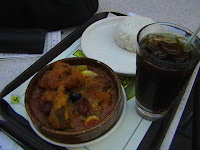
For dinner, we chose Porto Exterior where I had the Portuguese Chicken, which is much like the Filipino chicken curry we have here, but theirs have chorizos and black olives in the mix. My mother had the Fish with Cheese Sauce, which are generous portions of fish fillets breaded and fried to a crunch placed on top of rice fried in mild spices and scrambled egg bits. We had to balance our meals off with poached bok choy from Pho Hoa (yes, not really a traditional Macanese dinner, I admit). However, my mother and I were really more than satisfied with such a heavy meal and decided to walk our meal off afterwards with a tumbler of fresh fruits to take home.


We thought that our dinner was just a peculiar thing there in The Venetian, but our future meals in Macau were about the same thing - generous portions of everything. Our other meals included trying out the 24-hour cantonese dimsum place right next to our hotel. I'm sorry that I couldn't write down the name since it was only written in Cantonese. While they have a menu written in English, the staff do not speak any, and I was reduced to just pointing out the items we liked in the list as written in English while the waitstaff would read the counterpart Cantonese. Service was quick too. The food is just like what you get in the usual Chinese restaurants here in Manila - and then some. I had the crispy breaded pork chop rice meal, which they served with hot steaming broth and steamed cabbage and turnips. My mother had the beef with peppers on rice. We had the vegetable dumplings as a side with the usual soy and chili garlic sauces, but I still prefer the Filipino way of injecting kalamansi juice in the sauce for some bite and balance.
Macau as a cultural destination can be done in one day or less. I appreciated the fact that the Macau Chinese preserved as much of their history as they possibly can. The Senado square, the Maa Gok Temple (where the goddess A-ma resides) and the Ruins of St. Paul (which is the symbol for Macau) are World Heritage sites that are really worth seeing in person. As Macau thrives much on their tourism industry, it is only but proper for one to respect how organized the government is in coordinating everything well. Considering that they are Chinese whose sense of culture is quite strong and deeply felt, they also do not forget and likewise respect and embrace their historical and foreign influences. It is truly a blending of east and west.

Saturday, November 14, 2009

Hitting the Road


It's been quite some time since I made an entry here and I miss it actually. It's a bit funny though that during the time that typhoons were hitting the country, the internet service in my area was working well, but when the typhoons left, my service provider chose that time to strand me, and the rest of my province. I'm still looking for the logic in that.

And so, one of the things I quite missed during those trying times was the opportunity to just get up and and drive a car to anywhere. Of course, for my part the easiest route to take would be the Manila East road, which is well maintained as you go on stretches with nary an encounter with a bump on the road. This is the only stretch of road where one feels like there are only a few people in the Philippines.


What I like about road tripping are the little surprises that you get when you just take the time to stop and be curious. On this road, there is of course, the window shops of Paete displaying their wood carvings for sale. If you travel there during the -ber months, there is quite a buffet of Santas to choose from to decorate your house. There is also the showcase of the barong tagalog and saya along Lumban. The trip through these towns are short since they are small places, but it makes for such wonderful sights to see the culture thriving along the road. Then you know that you've reached Pagsanjan as soon as you see the old but well-preserved colonial Spanish houses there and the old wall marking the province as
established during the Spanish era. Then, if you reach Magdalena, there you will appreciate at how neat and peaceful the town and its people are, with their famously old church. They even have a memorial inside it signifying the short time that Apolinario Mabini rested in probably the last of his battles against the Spanish before he expired. The blood stains on his hat and sword are still there, brown and preserved in age.

For us, the final stop would be Liliw again. One naturally lands on the town after Magdalena. It's a little uphill and into their narrow streets which curved this way and that. We reached a very charming place called Balay Celina, a Bali-inspired bed and breakfast, quite a few minutes from the center of town. We were greeted by a friendly caretaker called Lasi who took care of us the moment we entered the gates, which is a distance from the main entrance.

As we entered the foyer, we are greeted by instant tranquility from the sounds of trickling water from the indoor pond, lush colors from the variety of plants alongside it, and natural light streaming in from every angle. One gets a glimpse of the garden pushed at the back of the house, leading to the swimming pool and another cottage for bigger groups or families who would like some more privacy. Every square inch of the house is made with natural and contrasting materials that really go together beautifully.

Lasi led us to our room, which is quite big. There were two double beds, a living area and tv with cable. The bathroom is likewise spacious and can probably accomodate the toiletries of six people. Indeed, the rooms of Balay Celina are made for sharing. We weren't prepared, however, with the little detail that they dont provide basic toiletries like shampoo, soap, toothbrush and toothpaste. But towels are big and clean.


The people of Balay Celina are very accommodating that they can drive you to the center of town for your shopping and sight seeing. Even if it takes you 2 hours to get there from Antipolo, one still gets tired from driving. An added note here is that parking spaces in the town proper are quite limited, so having them drop you off and picked up later in the day is an added and much valued amenity.

Sleep in Balay Celina is very peaceful and surprisingly cool. One then understands why the owners did not install air conditioning units in their rooms. Even if you close off your glass windows to prevent a variety of bugs from coming in, there are slits on the roof that allow air to come in and naturally circulate.

Breakfast at Celina is served generously. We were served pako omellette, which was an eye opener, pork longganisa, beef tapa, fried rice, fruits and coffee. You are given as many as you are able to wolf down. It is certainly your home away from home, as they would like you to feel.

Balay Celina has turned out to be just the reward you need at the end of a road trip. We will certainly come back.

Friday, October 2, 2009

Soup Kitchen


After the storm that is “Ondoy” and the devastation it left for many of our “kababayans”, here comes another one called “Pepeng/Parma”. Thankfully, it isn’t as strong in Metro Manila and nearby provinces, but there is still the winds and rainfall that encourage one to just spend the whole day indoors and cozy up in a couch with a book to read.

What better way to comfort one than a bowl of steaming hot soup. Here is a basic recipe that I use and have become popular with family and friends. It’s not the usual Pinoy soup though – like Pancit Molo and Chicken Sopas, but it has chicken stock as the all-familiar base and serves vegetables and herbs in a whole new light.

Cream of Parsley and Basil Soup

1 white onion, chopped
2 medium-sized potatoes, peeled and halved
2 T butter
1 c. chopped fresh parsley
½ c chopped fresh basil
4 c. chicken stock
½ c cream
salt & pepper to taste

Sauté chopped onion in butter until fragrant in a stockpot or casserole. Add chopped parsley and basil. Pour chicken stock and add potatoes, and boil until potatoes are cooked through and can be mashed. Turn off heat and add cream. Stir, and let it cool.

Take out the potatoes and mash them with a fork then stir back into soup. In batches, blend the soup in blender until ingredients are incorporated well. Heat up the creamed soup until it starts to boil and season with salt and pepper. Serve in individual bowls. Croutons are optional.

If you are serving this soup to someone who is lactose intolerant, replace cream with the same amount of evaporated filled milk.

Cream of Broccoli or Cauliflower Soup

It’s the same procedure actually, just replace the parsley and basil with 1 to 1 ½ cup/s chopped broccoli or cauliflower florets. Before pouring soup in individual bowls, melt cheese in the bowls first in the microwave before pouring soup in. You can also add whole broccoli or cauliflower florets as garnish. For the cauliflower soup, no need to add cheese in.

Cream of Carrot and Squash Soup

Again, the same ingredients but replace the parsley and basil with 1 cup squash and ½ cup chopped carrots. When serving, pour soup in individual bowls and add a dollop of sour cream. If you’re counting calories, a dollop of creamy or plain yogurt works equally well.